
Budget-Friendly Concrete Patio Design Ideas
Concrete Patio Ideas on a Budget: Affordable Outdoor Solutions
Table of Contents
Explore this Content with Smart Assistance
Creating an inviting outdoor living space doesn’t have to drain your bank account. Concrete patios offer some of the most versatile and budget-friendly options for homeowners looking to enhance their outdoor areas. At Legacy Concrete Construction and Landscaping, we’ve helped hundreds of Florida homeowners transform their backyards with affordable concrete patio solutions that combine durability with style.
In this comprehensive guide, we’ll explore concrete patio ideas on a budget that don’t sacrifice quality or aesthetic appeal. From understanding costs to creative design approaches and DIY options, you’ll discover how to maximize your outdoor space without breaking the bank.
Understanding Concrete Patio Costs
Before diving into design ideas, it’s essential to understand the typical costs associated with concrete patios. This knowledge will help you create a realistic budget and identify where you can potentially save money.
Average Cost Per Square Foot
The price per square foot of a concrete patio can vary significantly based on several factors, including location, design complexity, and finish options. According to HomeAdvisor’s 2023 cost analysis, basic concrete patios typically range from $4 to $8 per square foot for a plain gray slab, while decorative options can range from $8 to $20 per square foot depending on the techniques used.
- Basic concrete slab: $4-$8 per square foot
- Colored concrete: $8-$12 per square foot
- Simple stamped patterns: $10-$15 per square foot
- Complex stamped designs: $15-$20+ per square foot
In Florida specifically, costs tend to be in the middle of these ranges due to the competitive market and availability of materials. Local homeowners can expect to pay around $6-$7 per square foot for a basic concrete patio installation.
Cost Breakdown for a 20x20 Concrete Patio
A 20×20 concrete patio provides 400 square feet of outdoor living space—enough for furniture, grilling, and entertainment areas. Here’s a typical cost breakdown for a patio of this size:
Component | Basic Option | Mid-Range Option | Premium Option |
Materials | $1,200-$1,600 | $1,800-$2,400 | $3,000-$4,000 |
Labor | $1,600-$2,000 | $2,000-$2,800 | $2,800-$3,600 |
Equipment | $200-$400 | $400-$600 | $600-$800 |
Total | $3,000-$4,000 | $4,200-$5,800 | $6,400-$8,400 |
These estimates include site preparation, formwork, pouring the concrete, and basic finishing. Additional features like built-in seating or fire pits would increase these costs.
As noted by Concrete Network’s 2024 pricing guide, choosing a simple design and standard finish can keep your 20×20 patio closer to the $3,000-$4,000 range, representing significant savings compared to other patio materials like natural stone or pavers, which can cost $10-$30 per square foot.
Money-Saving Installation Strategies
Several approaches can help reduce concrete patio costs without compromising quality:
- Optimal timing: Schedule your installation during off-peak seasons (fall or winter in Florida) when contractors may offer better rates.
- Simplified shapes: Square and rectangular patios require less labor and material waste than curved or complex designs.
- Site preparation: Clear and level the site yourself before professionals arrive to reduce labor costs.
- Material choices: Using locally sourced aggregate can reduce material costs.
- Phased approach: Install a basic concrete slab now and add decorative elements like staining or stamping later when budget allows.
Want to know exactly how much your concrete patio project will cost? Contact our team for a free consultation and quote →
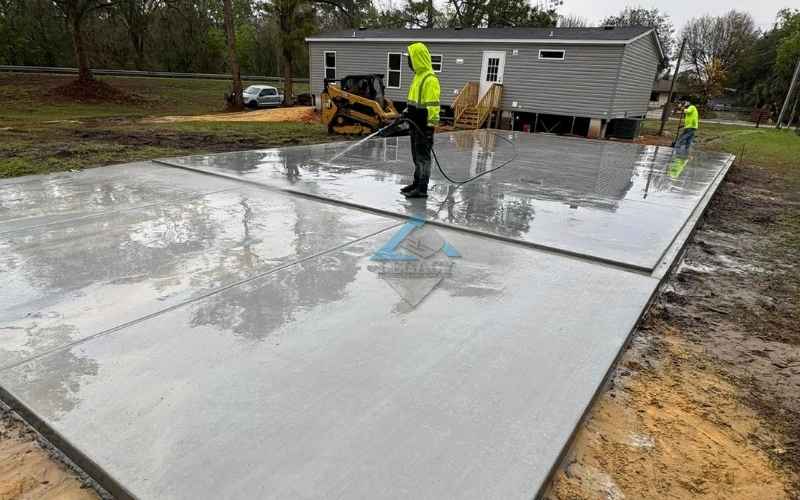
12 Budget-Friendly Concrete Patio Design Ideas
Creating an attractive concrete patio doesn’t require premium prices. Here are 12 budget-friendly design ideas that combine affordability with style:
Simple Slab Designs with Decorative Edges
1. Exposed Aggregate Border
Add visual interest to a plain concrete slab by incorporating an exposed aggregate border. This technique involves removing the top layer of cement to reveal the decorative stones beneath, creating texture and color variation. Cost addition: $1-$2 per square foot for borders only.
2. Scored Geometric Patterns
Using a concrete saw to cut simple geometric patterns into a basic slab creates the appearance of tiles at a fraction of the cost. According to the Family Handyman (2024), this technique can be done for as little as $0.50 per linear foot if DIY or $1-$2 per linear foot professionally.
3. Cantilevered Edges
Creating a slightly elevated or cantilevered edge adds a sophisticated detail to a standard slab without significantly increasing costs. This small design element makes the patio appear more custom-built and intentional.
Affordable Stamped Concrete Options
4. Single-Pattern Stamp
Instead of multiple patterns, use a single stamp design throughout the patio. The Concrete Network recommends this approach for saving 15-30% compared to multi-pattern designs while still achieving a high-end look.
5. Stamped Border with Plain Center
Apply stamping only to the edges of your patio while keeping the center plain. This creates visual interest where it matters most while reducing the overall project cost. HGTV’s “Budget-Friendly Backyard” series demonstrates how this technique saved homeowners an average of $700 on a 400-square-foot patio.
6. DIY Texture Stamping
Using simple texture mats or even household items like burlap can create subtle texture patterns for a fraction of the cost of professional stamping tools. This technique works best for adding slight texture rather than mimicking specific materials.
Concrete Patio and Fire Pit Combinations
7. Simple Concrete Fire Ring
A basic concrete fire ring integrated into your patio design costs significantly less than prefabricated fire pit units while creating a natural gathering spot. According to DIY Network, a simple 3-foot diameter concrete fire ring can be built for $200-$300 in materials.
8. Gravel Surround Fire Pit Area
Create a designated fire pit zone by surrounding a metal fire bowl with gravel on your concrete patio. This creates visual interest through material contrast while being extremely budget-friendly. As recommended by Better Homes & Gardens, this approach saves 40-60% compared to built-in fire features.
9. Repurposed Material Fire Pit
Use reclaimed brick or concrete blocks to create a fire pit on your patio. This sustainable approach not only saves money but adds character through materials with history.
Mixing Materials for Visual Interest
10. Concrete and Gravel Combination
Alternate sections of poured concrete with compacted gravel to reduce the overall concrete needed while creating visual texture. The Spruce reports this technique can reduce material costs by up to 30%.
11. Concrete Stepping Stones
Instead of a solid slab, create large concrete stepping stones or pads connected by gravel, grass, or ground cover. This dramatically reduces the amount of concrete needed while creating an interesting visual pattern.
12. Concrete and Wood Hybrid
Combine a concrete pad with wooden decking elements for a multi-level, multi-textured space that maximizes visual impact while minimizing concrete costs. According to Landscaping Network, this approach allows homeowners to extend their outdoor living space for 40-60% less than using a single premium material throughout. Many homeowners working with a landscaper Orange County and across Central Florida have found this hybrid approach ideal for achieving a high-end look on a modest budget.
Each of these design approaches can be customized to fit your specific space, style preferences, and budget constraints. The key is focusing on simple designs with strategic decorative elements rather than complex, labor-intensive installations.
Cost-Effective Concrete Finishes and Textures
The finish you choose for your concrete patio can dramatically impact both its appearance and cost. Here are affordable finishing options that provide excellent results:
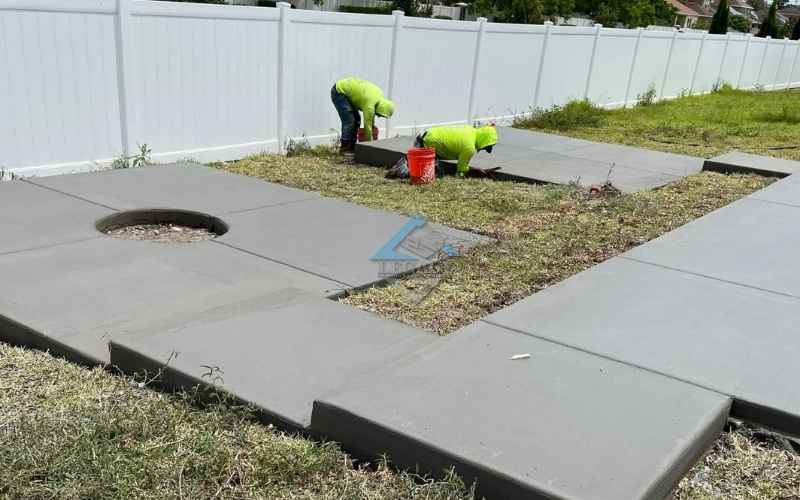
Types of Budget-Friendly Concrete Finishes
1. Broom Finish
This classic texture is created by dragging a broom across freshly poured concrete. It provides slip resistance and a subtle texture at virtually no additional cost over a basic slab. According to Concrete Construction Magazine, this remains the most economical finish option while providing excellent functionality.
2. Salt Finish
This classic texture is created by dragging a broom across freshly poured concrete. It provides slip resistance and a subtle texture at virtually no additional cost over a basic slab. According to Concrete Construction Magazine, this remains the most economical finish option while providing excellent functionality.
3. Float & Trowel Finishes
Various degrees of smoothness can be achieved during the concrete finishing process, from slightly textured to completely smooth. These finishes are included in basic installation costs and require no additional materials.
4. Seeded Aggregate
Similar to exposed aggregate but more budget-friendly, this technique involves broadcasting decorative stone over wet concrete and pressing it in, without the additional step of exposing it through washing. Cost addition: approximately $0.75-$1.50 per square foot.
5. Rock Salt Finish
Rock salt pressed into fresh concrete and then dissolved creates small pits that add texture and visual interest. This technique adds only about $0.50-$1.00 per square foot to your project cost.
DIY Concrete Staining Techniques
Staining is one of the most cost-effective ways to add color and character to a concrete patio:
1. Acid Staining
DIY acid staining kits cost $0.30-$0.40 per square foot for materials, compared to $2-$4 per square foot for professional application. The process involves applying acid-based solutions that react with minerals in the concrete to create unique, variegated colors. Popular home improvement blogger “DIY Pete” documented achieving professional-level results with acid staining for under $200 on a 400-square-foot patio.
2. Water-Based Stains
Even more DIY-friendly than acid stains, water-based concrete stains cost $0.25-$0.35 per square foot for materials and provide more consistent coloring. These stains don’t rely on chemical reactions but instead deposit pigment on the surface.
3. Concrete Paint and Tinted Sealers
For the most budget-conscious approach, concrete-specific paints and tinted sealers combine color and protection in one application. At $0.15-$0.30 per square foot for materials, this represents the most economical coloring option.
Home Depot’s concrete finishing guide recommends water-based stains for beginners due to their forgiving application process and environmentally friendly formula.
Sealing Stamped Concrete Patios Affordably
Proper sealing is crucial for protecting your concrete patio investment, particularly for decorative finishes:
1. Acrylic Sealers
The most economical option at $0.15-$0.25 per square foot for materials. These water-based or solvent-based products provide good protection for 1-3 years before needing reapplication.
2. Penetrating Sealers
Slightly more expensive at $0.25-$0.40 per square foot, these sealers penetrate the concrete for longer-lasting protection without changing the surface appearance. Ideal for those who prefer a natural look.
3. DIY Application
Applying sealer yourself can save $1-$2 per square foot compared to professional application. Most sealers can be applied with standard garden sprayers or rollers following manufacturer instructions.
Ready to explore budget-friendly concrete patio options for your home? Schedule your free consultation today →
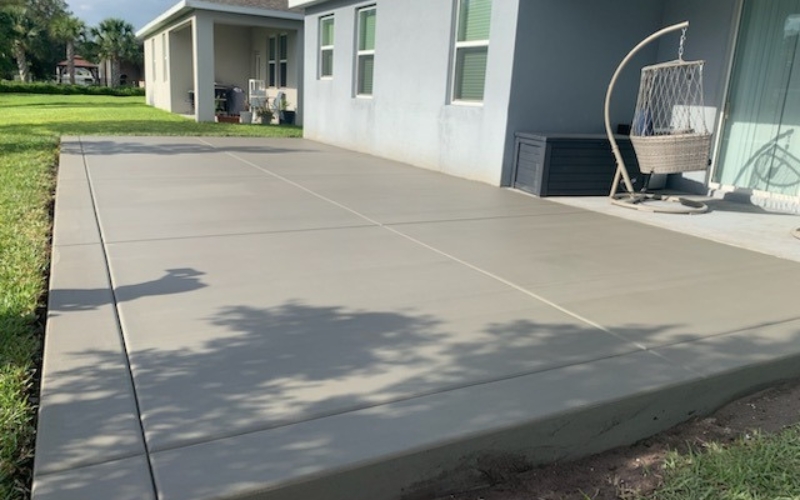
DIY Concrete Patio Installation Guide
For the most budget-conscious approach, installing a concrete patio yourself can save 40-60% on labor costs. Here’s what you need to know:
Tools and Materials Needed
Essential Tools:
- Tape measure and string line
- Shovel and rake
- Tamper (hand or power)
- Wheelbarrow
- Bull float and concrete trowels
- Edging tool
- Concrete groover/jointer
- Push broom (for texture)
- Level
- 2×4 lumber for screeding
Materials:
- Gravel for base (approximately 2-3 inches deep)
- Concrete forms (2x4s or flexible form boards)
- Rebar or wire mesh for reinforcement
- Ready-mix concrete OR concrete mix bags
- Concrete sealer
Step-by-Step Installation Process
Planning and Layout
- Mark your patio dimensions using stakes and string
- Check for square corners using the 3-4-5 method
- Contact utilities to mark underground lines before digging
- Ensure proper slope for drainage (1/4 inch per foot away from house)
Site Preparation
- Remove grass and topsoil to a depth of 6-8 inches
- Compact the soil thoroughly with a tamper
- Add 2-3 inches of gravel base and compact again
- Set concrete forms to desired height and secure with stakes
Reinforcement Installation
- Place rebar grid or wire mesh, suspending it in the middle of the slab
- Keep reinforcement 2-3 inches from edges
- Use rebar chairs or stones to hold reinforcement at proper height
Pouring Concrete
- Calculate concrete needed (length x width x depth in feet ÷ 27 = cubic yards)
- For smaller patios, mixing bags is economical (about 60 bags for a 10×10 patio)
- For larger patios, ready-mix delivery saves time and labor
- Pour concrete into forms starting from the furthest point
Finishing the Surface
- Screed the surface using a 2×4 in a sawing motion across forms
- Use a bull float to smooth surface and remove high/low spots
- Let concrete set until water disappears from surface
- Edge the perimeter with an edging tool
- Create control joints every 8-10 feet using a groover
- Apply desired finish (broom, trowel, etc.)
- Cure the concrete by keeping it moist for 3-7 days
Common DIY Mistakes to Avoid
Inadequate Base Preparation
- Skipping proper compaction and base material leads to cracking and settling. According to This Old House, “Nearly 80% of concrete failures stem from poor base preparation.”
Improper Concrete Mix
- Using the wrong strength concrete or adding too much water weakens the final product. Aim for a 3000-4000 PSI mix for patios.
Missing Reinforcement
- Skipping rebar or wire mesh significantly increases crack risk, particularly in Florida’s soil conditions.
Forgetting Control Joints
- Without proper joints, concrete will crack randomly rather than at controlled locations. Joints should be cut to 1/4 the depth of the slab.
Poor Curing Techniques
- Concrete needs proper moisture while curing. Too rapid drying leads to surface weakness and cracking.
Sealing Too Soon
- Applying sealer before concrete is fully cured (typically 28 days) can trap moisture and cause clouding or delamination.
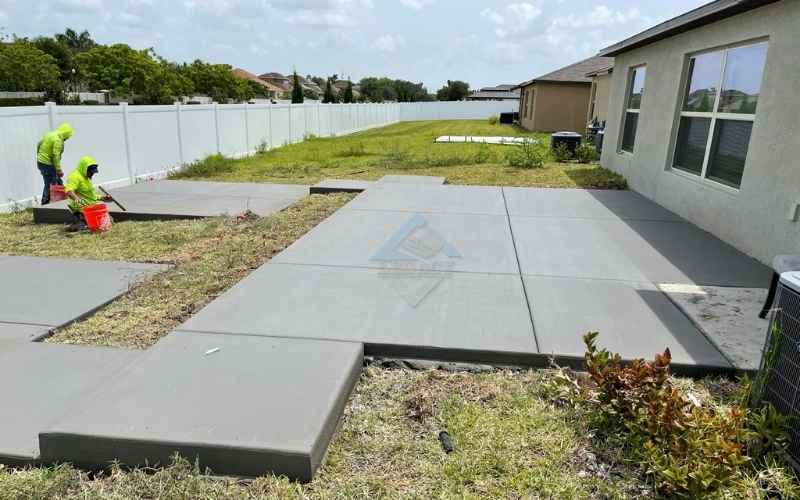
Budget-Friendly Concrete Patio Resurfacing Options
If you already have a concrete patio that’s showing its age, resurfacing can be much more economical than replacement. According to ConcreteNetwork.com’s 2023 cost comparison, resurfacing typically costs 30-50% less than complete replacement.
Overlay and Microtopping Solutions
1. Concrete Microtopping
Ultra-thin layer (1/16″ to 1/8″) applied over existing concrete to create a fresh, smooth surface. Cost: $3-$5 per square foot, compared to $6-$10 for replacement.
2. Stampable Overlays
1/4″ to 1/2″ thick polymer-modified concrete layers that can be stamped with patterns. Cost: $5-$8 per square foot, offering 30-40% savings over new stamped concrete.
3. Spray-Down Texture Coating
Sprayed application creates a textured, slip-resistant surface at $3-$5 per square foot, ideal for poolside patios.
Repair vs. Replace Considerations
Consider these factors when deciding between resurfacing and replacement:
- Structural Integrity: If your existing patio has severe cracking, heaving, or settling issues, resurfacing may not be appropriate. According to The Concrete Network, “Cracks wider than 1/4 inch or differences in elevation indicate structural issues that should be addressed through replacement.”
- Cost Comparison: For a typical 400 square foot patio:
- Complete replacement: $2,400-$3,200
- Resurfacing: $1,200-$2,000
- Basic repair and sealing: $500-$900
- Longevity: Quality resurfacing can last 8-15 years with proper maintenance, while new concrete typically lasts 20-30 years. Consider the cost-to-lifespan ratio in your decision.
- Aesthetic Goals: If you want to completely redesign the shape or size of your patio, replacement may be necessary. Resurfacing works best when you’re satisfied with the existing footprint.
DIY Resurfacing Techniques
Several resurfacing options are suitable for DIY application:
1. Concrete Microtopping
For small cracks and spalls, patching compounds cost $20-$40 per gallon and can be applied with minimal skills. This Old House recommends Quikrete’s Concrete Resurfacer for DIY applications.
2. Concrete Stain and Seal
For concrete with good structural integrity but poor appearance, cleaning thoroughly and applying stain and sealer can refresh the look for approximately $0.50-$1.00 per square foot in materials.
3. DIY Overlay Kits
Several manufacturers offer DIY-friendly overlay systems with detailed instructions. These typically cost $1.50-$3.00 per square foot for materials, compared to $3-$5 for professional application.
Maintaining Your Budget Concrete Patio
Proper maintenance is the most cost-effective way to protect your concrete patio investment. A well-maintained concrete patio can last decades with minimal expense.
Seasonal Maintenance Tips
1. Spring Maintenance
- Thoroughly clean the surface with mild detergent
- Check for winter damage and address small cracks
- Apply sealer if it’s been 2-3 years since last application
- Inspect drainage to ensure proper flow away from patio
2. Summer Care
- Clean spills promptly, especially acidic substances like wine or BBQ sauce
- Use furniture protectors to prevent scratching
- Avoid using metal shovels or tools that can scratch the surface
- In Florida’s heat, occasionally mist sealed concrete during extreme heat to prevent thermal cracking
3. Fall Preparation
- Remove leaf stains promptly as tannins can penetrate concrete
- Clean and store patio furniture properly
- Apply sealer before winter if needed
- Check that water drains properly away from the patio
4. Winter Protection (Even in Florida)
- Avoid using deicing chemicals, as these can damage concrete surfaces
- Use plastic shovels rather than metal for removing any debris
- Cover valuable furniture to protect both it and the patio surface
Preventing Costly Damage
1. Regular Sealing
- Apply quality concrete sealer every 2-3 years to prevent moisture penetration and staining. This $0.15-$0.30 per square foot investment prevents much costlier repairs.
2. Prompt Crack Repair
- Address small cracks immediately with appropriate fillers to prevent water infiltration and crack expansion.
3. Proper Furniture Selection
- Use furniture with wide feet or protectors to distribute weight and prevent surface damage.
4. Grill Mats
- Place protective mats under grills and fire features to prevent oil stains and heat damage.
5. Plant Placement
- Avoid placing potted plants directly on concrete, as they can cause persistent moisture and staining. Use plant stands instead.
Frequently Asked Questions About Budget Concrete Patios
How much does a basic concrete patio cost per square foot?
In Florida, basic concrete patios typically cost $6-$8 per square foot for plain gray concrete with a simple finish. Decorative options add $2-$10+ per square foot depending on complexity.
Is it cheaper to do pavers or concrete for a patio?
Concrete is typically 30-40% less expensive than pavers for the same square footage. According to HomeAdvisor’s 2023 cost comparison, concrete averages $6-$8 per square foot while pavers run $10-$17 per square foot installed.
How thick should a concrete patio be?
For residential patios, a thickness of 4 inches is standard, with proper base preparation. Areas with freeze-thaw cycles or poor soil conditions may require 5-6 inches. The American Concrete Institute recommends a minimum of 3.5 inches for patios that will only have foot traffic.
How long will a concrete patio last?
With proper installation and maintenance, a concrete patio can last 25-30 years or longer. According to the Portland Cement Association, sealing every 2-3 years can significantly extend this lifespan.
Can I pour concrete directly over dirt?
No, pouring concrete directly over dirt will lead to settling and cracking. A proper base of 4-6 inches of compacted gravel is essential for drainage and stability.
What is the best month to pour concrete in Florida?
In Florida, the ideal months for pouring concrete are October through April when temperatures are moderate. Extreme summer heat can cause concrete to cure too quickly, potentially reducing strength and durability.
Is stamped concrete worth the extra cost?
Stamped concrete costs 30-50% more than plain concrete but offers 70-80% of the aesthetic appeal of natural stone at roughly half the price. For many homeowners, this represents an excellent value proposition for improving home appearance and value.
How soon can you walk on newly poured concrete?
You can typically walk on newly poured concrete after 24-48 hours, but it should not receive heavy furniture or vehicle traffic for at least 7 days. Full curing takes 28 days.
Why Choose Legacy Concrete Construction and Landscaping
With almost 10 years of experience serving Florida homeowners, Legacy Concrete Construction and Landscaping specializes in creating beautiful, durable concrete patios that fit any budget. Our team of certified concrete professionals understands the unique challenges of Florida’s climate and soil conditions.
We pride ourselves on transparent pricing, quality craftsmanship, and helping homeowners make informed decisions about their outdoor living spaces. Whether you’re looking for a simple, functional patio or a decorative outdoor entertainment area, we can help you achieve your goals within your budget.
Our services include:
- Free on-site consultations and estimates
- Customized design recommendations
- Full-service installation
- Decorative concrete options
- Resurfacing and repair services
- Concrete maintenance programs
Ready to transform your outdoor space with a budget-friendly concrete patio? Contact us today for a free consultation and estimate. Our team will help you explore options that meet your aesthetic preferences, functional needs, and budget constraints.
Share this content: